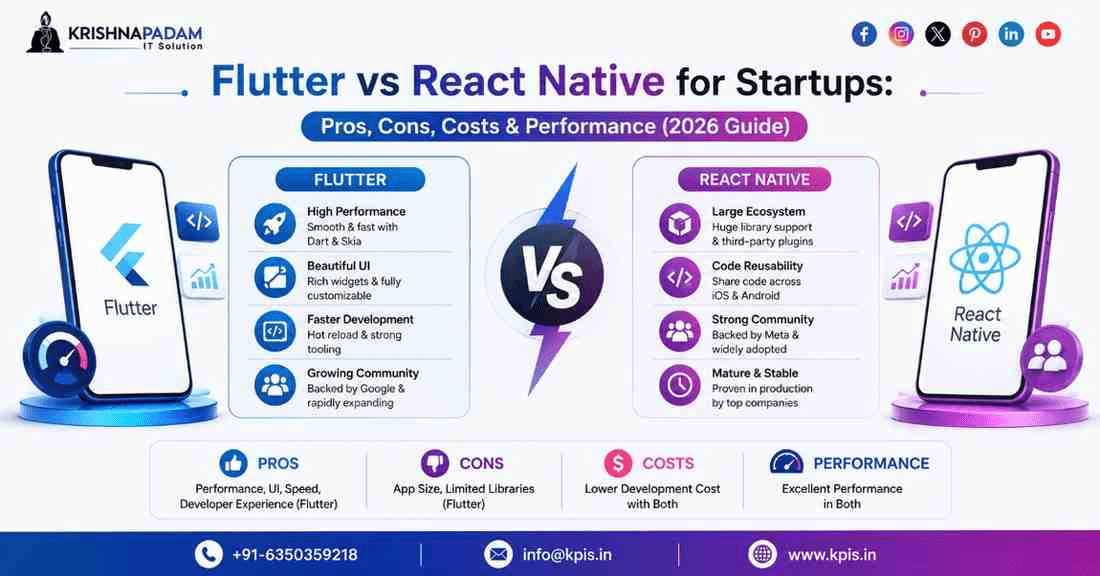
Imagine this: your startup has a brilliant app idea, investors are interested, and your team is ready to start development. But before writing a single line of code, you’re faced with a critical decision that could impact your budget, launch timeline, user experience, and future growth. In this comprehensive comparison, we’ll break down Flutter vs React Native for Startups: Which Is Better for MVPs, Scaling, Performance, and Cost in 2026?
Did you know?
Over 50%+ of startups choose a cross-platform framework to reduce MVP cost and time-to-market.
Apps built with cross-platform tools can reduce development cost by 30%-60% compared to native development.
Flutter and React Native together power thousands of production apps from fintech tools to global social platforms.
If you’re a startup founder, your framework choice is not just technical, it directly impacts funding runway, launch speed, hiring, and scalability.
What Is Cross-Platform App Development for Startups?
Cross-platform development allows startups to build one codebase that runs on both iOS and Android, instead of building separate native apps.
Why it matters:
Startups typically operate under:
- Limited funding
- Tight deadlines
- Fast iteration cycles
So reducing duplicate engineering work becomes a major advantage.
Why Startups Choose Cross-Platform Frameworks
Modern startups move fast. They test ideas quickly, validate products rapidly, and pivot when needed. That’s why cross-platform frameworks are becoming the default choice.
Key Benefits for Startups
- Faster time to market
- Lower development cost
- Smaller development team required
- Easier maintenance and updates
Single codebase for Android and iOSFor early-stage startups, speed and cost efficiency are often more important than platform-specific optimization.
What is Flutter
Flutter is an open-source UI framework developed by Google. It uses the Dart programming language and allows developers to build natively compiled apps for mobile, web, and desktop.
Key Features of Flutter
- Single codebase for multiple platforms
- Fast development with Hot Reload
- Rich customizable widgets
- Strong UI consistency
- Excellent animation capabilities
- High-performance rendering engine
Popular apps built with Flutter include Google Pay, Alibaba, BMW, and eBay Motors.
What is React Native
React Native is an open-source framework developed by Meta (Facebook). It allows developers to build mobile apps using JavaScript and React.
Key Features of React Native
- JavaScript-based development
- Reusable code across platforms
- Large developer ecosystem
- Extensive third-party libraries
- Strong community support
- Faster onboarding for web developers
Popular apps built with React Native include Facebook, Instagram, Shopify, Discord, and Walmart.
Flutter vs React Native: Key Differences
When comparing Flutter and React Native, the real difference is not just “which is better,” but how each one builds and renders your app internally. That architectural difference impacts performance, UI behavior, and long-term scaling.
Performance and Speed
- Flutter generally offers better performance because it uses its own rendering engine, reducing reliance on platform bridges.
- React Native is fast but may experience performance limitations in complex animations or heavy UI workloads.
UI/UX and Design Flexibility
- Flutter provides pixel-perfect UI control, making it ideal for custom and visually rich applications.
- React Native depends more on native components, which can sometimes lead to slight UI inconsistencies across platforms.
Development Experience
- Flutter: Requires learning Dart but offers a unified development experience
- React Native: Easier for developers familiar with JavaScript and React
Startups with web teams often adopt React Native faster.
Community and Ecosystem
- React Native has a longer market presence and larger community, meaning more third-party libraries and solutions.
- Flutter is growing rapidly and is strongly supported by Google, especially for long-term ecosystem expansion.
Scalability for Startups
Both frameworks scale well, but:
- Flutter: Better for long-term product consistency
- React Native: Better for rapid MVP development and iteration
Pros and Cons of Flutter Every Business Should Know
Flutter is a strong choice for startups that want high performance and a consistent user experience across platforms, but it also has a few limitations depending on team skill and project needs.
Pros
- High performance and smooth animations
- Same UI on Android and iOS (very consistent design)
- Fast development with hot reload
- Good for long-term scalable apps
- Strong control over UI design
Cons
- Uses Dart (new language, harder for beginners)
- Bigger app size compared to other frameworks
- Smaller developer community than JavaScript
- Fewer third-party libraries than React Native
Pros and Cons of React Native for App Development (2026)
React Native is widely used by startups because it enables fast MVP development using JavaScript, but it also comes with trade-offs in performance and long-term complexity.
Pros
- Very fast for building MVPs
- Uses JavaScript (easy for most developers)
- Large community and ecosystem
- Easy hiring of developers
- Feels more like native apps
Cons
- Performance issues in complex apps
- UI can differ between Android and iOS
- Some libraries are outdated or unstable
- Can get messy in large projects over time
Which Framework Gives Startups a Competitive Edge: Flutter or React Native?
Choosing between Flutter and React Native is one of the most important technical decisions for a startup because it directly impacts speed to market, development cost, performance, and long-term scalability. For startups, the choice between Flutter and React Native depends on business goals.
- Flutter is better for startups that need high performance, consistent UI design, and long-term scalability. It is ideal for apps with rich animations, custom interfaces, and complex user experiences.
- React Native is better for startups that want faster MVP development, lower initial cost, and easier hiring, especially if the team already knows JavaScript.
Cost and Time to Build a Startup App (Flutter vs React Native)
The cost and development time for a startup app using Flutter or React Native depends on app complexity, features, and team experience.
Typical Development Time
- Simple MVP app: 4-8 weeks
- Medium complexity app: 2-4 months
- Complex startup app: 4-8+ months
React Native is often slightly faster for MVPs because it uses JavaScript and has a larger pool of developers. Flutter may take a bit longer initially due to Dart learning and setup, but it becomes efficient for scaling and UI-heavy apps.
Typical Cost Range
- Basic MVP: $3,000 – $15,000
- Mid-level startup app: $15,000 – $50,000
- Advanced scalable app: $50,000 – $150,000+
React Native can reduce early-stage cost due to faster onboarding and reusable web skills. Flutter may reduce long-term UI redesign and maintenance costs because of its consistent rendering system.
Key Insight
- React Native = lower upfront cost + faster MVP launch
- Flutter = better long-term efficiency + stable UI at scale
Both frameworks significantly reduce cost compared to native development, and the real expense depends more on features, design complexity, and development team expertise than the framework itself.
Real-World Use Cases and Industry Adoption: Flutter vs React Native
Startups and companies use both Flutter and React Native across different industries based on product needs, performance requirements, and team expertise.
Common Use Cases for Flutter
Flutter is widely used for apps that require high-performance UI, smooth animations, and consistent design across platforms. It is commonly chosen for:
- Fintech and banking apps with secure dashboards
- E-commerce apps with rich UI and product catalogs
- Healthcare and booking applications
- Apps requiring custom animations and branding consistency
Flutter is preferred when startups want a highly polished user experience and scalable design system.
Common Use Cases for React Native
React Native is widely used for apps that prioritize fast development, quick updates, and strong JavaScript ecosystem support. It is commonly used for:
- Social media and community apps
- MVPs and early-stage startup products
- Content-driven apps (news, blogs, media platforms)
- Apps requiring rapid iteration and frequent updates
React Native is preferred when startups need to launch quickly and validate product-market fit.
Industry Adoption Insight
Both frameworks are production-ready and widely adopted. Flutter is gaining strong adoption in product-focused startups, while React Native remains dominant in teams with existing JavaScript or web development backgrounds.
The best choice depends on whether the startup prioritizes product polish or speed to market.
When should startups choose Flutter or React Native?
Startups should choose Flutter when they need high-performance apps, consistent UI across Android and iOS, and long-term scalability. Flutter is ideal for apps with custom designs, smooth animations, and feature-rich user experiences.
Choose Flutter If:
- You need high-performance animations and fast rendering
- You want a consistent UI across multiple platforms
- Your app requires custom design and branding flexibility
- You plan to scale the product long term
- User experience and visual quality are top priorities
Startups should choose React Native when they want faster development, lower initial costs, and easier onboarding for JavaScript developers. It is commonly used for MVPs and rapid product launches.
Choose React Native If:
- You already have a JavaScript or React development team
- You want to launch an MVP quickly
- Speed to market is your primary goal
- You need rapid testing and iteration
- You want access to a large JavaScript ecosystem
The best framework depends on your startup’s goals. Flutter is often better for long-term product quality, while React Native is usually better for rapid startup execution and validation.
What are the latest tech trends in Flutter and React Native?
The latest trends in Flutter and React Native show a strong shift toward faster performance, better developer experience, and deeper integration with native platforms for scalable mobile app development.
Key Trends in Flutter
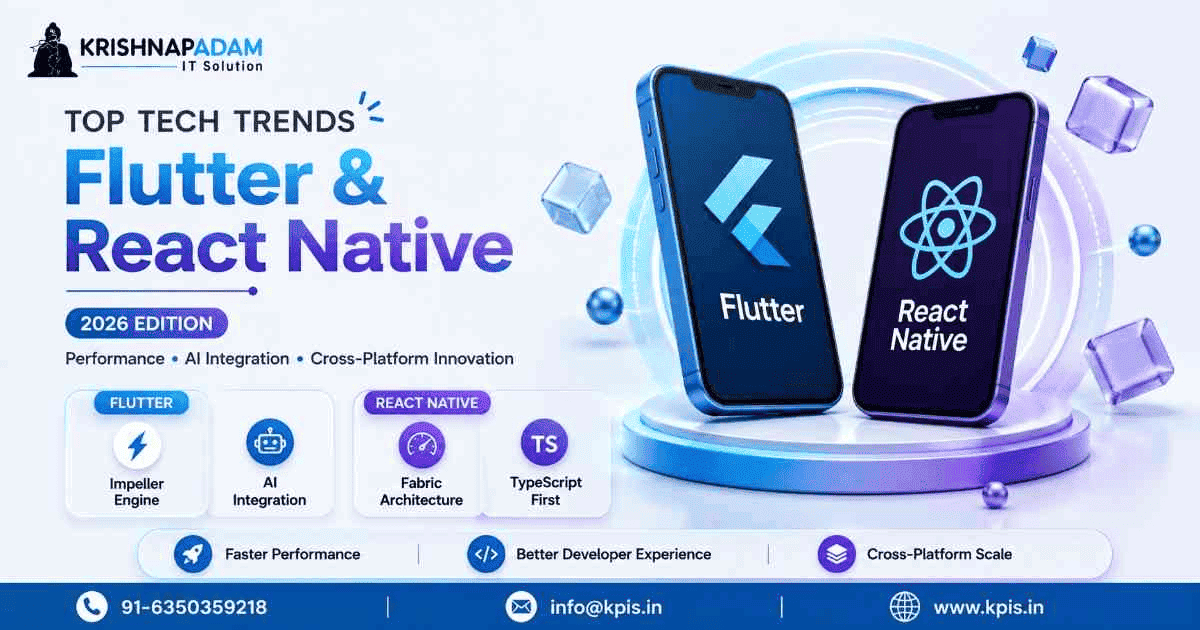
- Impeller Rendering Engine replacing older rendering systems for smoother animations and better performance
- Flutter Web and Desktop Expansion for true multi-platform apps (mobile, web, desktop)
- Dart Improvements focused on faster compilation and better developer productivity
- AI Integration in Apps using on-device ML and generative AI features
- Custom UI Systems for highly branded and design-heavy applications
Flutter is trending toward becoming a unified UI framework for all platforms, not just mobile.
Key Trends in React Native
- New Architecture (Fabric + TurboModules) improving performance and reducing bridge overhead
- Better Native Integration for smoother performance in complex apps
- Improved Developer Tooling with faster builds and debugging
- TypeScript Adoption becoming standard for safer large-scale apps
- Strong Expo Ecosystem Growth simplifying development and deployment
React Native is trending toward near-native performance with simpler developer experience.
Why Choose Krishna Padam IT Solution for Flutter and React Native Development?
Did you know that most users decide whether they like an app within the first few seconds? A slow, outdated, or poorly designed mobile app can cost startups valuable users, revenue, and growth opportunities.
That’s why choosing the right technology and development partner matters from day one. At Krishna Padam IT Solution, we build fast, scalable, and visually engaging mobile applications using Flutter and React Native to help startups launch smarter and grow faster. From MVP development to full-scale mobile solutions, our team focuses on performance, user experience, and long-term scalability.
Why Choose Krishna Padam IT Solution?
- Skilled Flutter and React Native developers
- Faster MVP launch for startups
- Cost-effective cross-platform development
- Modern and user-friendly UI/UX design
- Scalable architecture for future growth
- Complete support from planning to deployment
- Transparent process with timely delivery
Conclusion: Ready to Turn Your Startup Idea Into a Powerful Mobile App?
The right framework can save your startup months of development time and thousands in engineering costs. Before making a decision, evaluate your product complexity, target audience, and future scalability needs carefully.
Need help choosing the best tech stack for your startup? When you hire our Flutter and React Native developers, you get a reliable technology partner focused on delivering quality, speed, and long-term success for your business.
Hire expert developers from Krishna Padam IT Solution today and turn your startup idea into a powerful mobile application that stands out in the market.