If you’re planning to build an AI chatbot, customer support assistant, enterprise search solution, or knowledge management platform, understanding RAG is no longer optional it’s becoming the industry standard. In this comprehensive guide, you’ll learn why is retrieval-augmented generation (RAG) the future of AI chatbots?
Imagine asking an AI chatbot a critical business question and receiving an answer that isn’t just fluent but backed by your company’s latest documents, policies, databases, and knowledge base in seconds. That’s the difference between traditional AI chatbots and Retrieval-Augmented Generation (RAG).
For years, businesses struggled with AI hallucinations, outdated information, and unreliable responses. While large language models (LLMs) revolutionized conversational AI, they also exposed a major weakness, they only know what they were trained on and can confidently generate incorrect information.
Retrieval-Augmented Generation changes that completely.
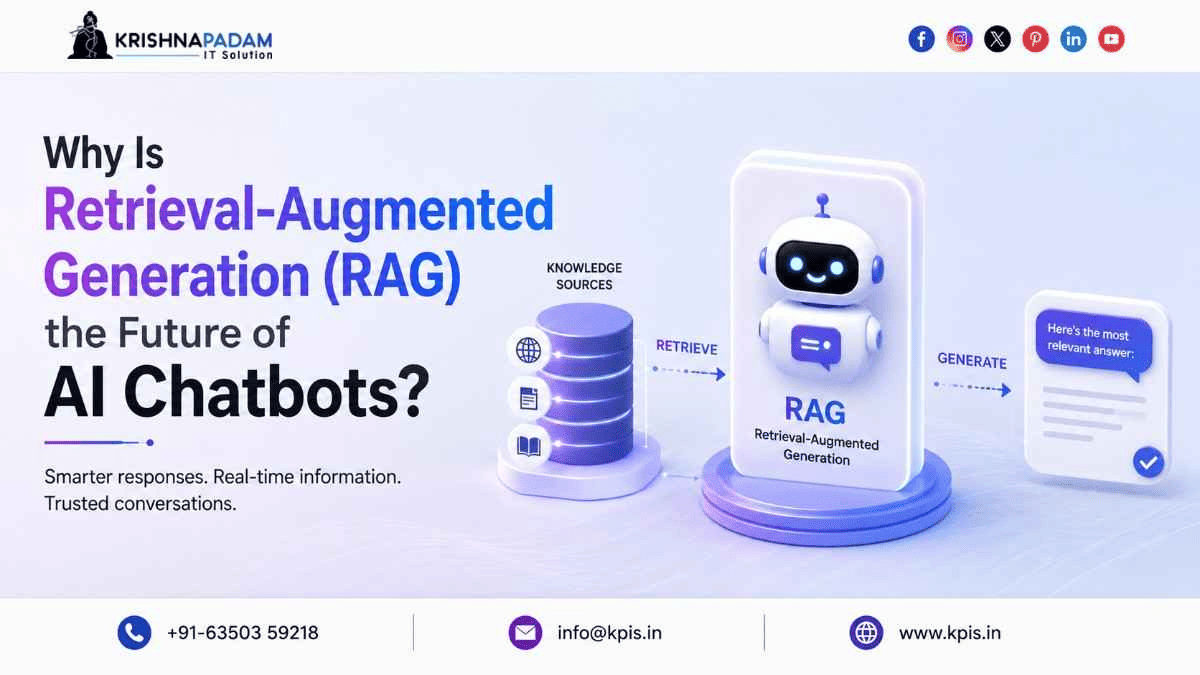
Instead of relying solely on pre-trained knowledge, RAG retrieves relevant information from trusted sources before generating a response. The result? AI chatbots that are significantly more accurate, context-aware, trustworthy, and enterprise-ready.
Let’s explore why experts consider Retrieval-Augmented Generation the future of AI chatbots.
What Is Retrieval-Augmented Generation (RAG)?
Retrieval-Augmented Generation (RAG) is an AI architecture that combines two powerful capabilities:
- Information Retrieval – Searching trusted external knowledge sources such as databases, documents, PDFs, websites, APIs, or internal company data.
- Generative AI – Using a Large Language Model (LLM) to generate natural, conversational responses based on the retrieved information.
Instead of relying solely on what the AI memorized during training, RAG enables the model to access relevant information in real time before answering. Think of it like this:
- A traditional chatbot answers from memory.
- A RAG chatbot answers after checking reliable references.
That difference dramatically improves accuracy, trustworthiness, and relevance.
Why Traditional AI Chatbots Have Limitations
Large Language Models such as GPT, Gemini, Claude, and Llama are incredibly capable, but they are not designed to know everything that happens after their training. Understanding these limitations explains why Retrieval-Augmented Generation has become so important.
Knowledge Can Become Outdated
AI models are trained on massive datasets collected over a specific period. After training is complete, they do not automatically learn new information. For example, they may not know about:
- New government regulations
- Recently launched products
- Updated company policies
- Current market prices
- Breaking news
- Newly published research
Without an external knowledge source, responses can become outdated over time.
Hallucinations
AI models sometimes generate answers that sound convincing but are factually incorrect. This phenomenon is known as an AI hallucination. For businesses, hallucinations can lead to:
- Customer misinformation
- Compliance risks
- Poor decision-making
- Loss of user trust
No Access to Private Business Data
Every organization has valuable information that is unavailable on the public internet. Examples include:
- Internal documentation
- Employee handbooks
- CRM systems
- Knowledge bases
- Enterprise databases
Traditional AI models cannot answer questions about this information unless it is made available through a retrieval system.
How Retrieval-Augmented Generation Works
Although RAG is built using advanced AI technologies, its workflow is surprisingly easy to understand.
Step 1: The User Asks a Question
A customer, employee, or student asks a question.
Example:
“What is our latest remote work policy?”
At this stage, the AI does not immediately generate an answer.
Step 2: The Retrieval System Searches for Relevant Information
The retrieval engine searches trusted data sources for documents related to the user’s question. These sources may include:
- Company knowledge bases
- PDF documents
- Websites
- Databases
- Product documentation
- CRM systems
- Cloud storage
- APIs
Instead of searching the entire database randomly, modern RAG systems use semantic search to identify information based on meaning rather than exact keywords.
Step 3: The AI Receives Context
The retrieved documents are provided to the language model as context.
Rather than guessing, the AI now has verified information available before generating its response.
This is one of the biggest reasons RAG improves accuracy.
Step 4: The AI Generates a Natural Response
The language model combines three important elements:
- The user’s question
- Retrieved information
- Conversation history
The result is a clear, conversational answer grounded in relevant data.
Why RAG Is the Future of AI Chatbots
The popularity of RAG is growing because it solves many of the challenges businesses face when deploying AI.
Real-Time Knowledge
One of the biggest advantages of RAG is access to up-to-date information. Instead of waiting months for model retraining, chatbots can retrieve:
- Today’s pricing
- Current inventory
- Live documentation
- Updated policies
- Breaking news
- Latest research
This makes responses significantly more relevant.
Dramatically Reduces Hallucinations
Because the AI bases responses on retrieved evidence, there’s much less guessing. This improves:
- Accuracy
- Reliability
- User trust
- Business confidence
For enterprise applications, this benefit is invaluable.
Better Customer Support
Customers expect instant answers. RAG-powered chatbots can search:
- Product manuals
- Help center articles
- Warranty policies
- Troubleshooting guides
Instead of generic replies, users receive personalized, evidence-backed assistance.
Enterprise AI Without Retraining
Organizations constantly update:
- Documentation
- Policies
- SOPs
- Product catalogs
- HR resources
With RAG, simply updating documents is enough. There’s no need to retrain the language model every time information changes.
More Cost-Effective Than Fine-Tuning
Fine-tuning AI models can be:
- Expensive
- Time-consuming
- Difficult to maintain
RAG often provides similar improvements while avoiding repeated model training. Businesses can update their knowledge base instead of rebuilding AI models.
Personalized Responses
RAG enables AI to retrieve user-specific information such as:
- Account details
- Purchase history
- Support tickets
- Subscription plans
- Organization-specific documents
This creates highly personalized conversations.
Better Compliance and Security
Many industries require AI responses to come from approved documentation. Examples include:
- Healthcare
- Finance
- Insurance
- Government
- Legal services
RAG helps ensure responses are grounded in trusted internal sources, supporting compliance requirements while reducing the risk of unsupported answers.
Real-World Applications of Retrieval-Augmented Generation
RAG is already being adopted across multiple industries because it solves real business problems.
Healthcare
Healthcare organizations use RAG to search clinical guidelines, medical literature, and hospital documentation, helping professionals quickly access relevant information.
Financial Services
Banks and financial institutions use RAG to answer questions about policies, compliance requirements, investment products, and customer services.
E-commerce
Online stores use RAG to provide accurate answers about product specifications, availability, shipping, returns, and warranties.
Education
Educational platforms use RAG to help students search lecture notes, digital libraries, research papers, and course materials.
Enterprise Knowledge Management
Companies use RAG to give employees instant access to internal documentation without manually searching through thousands of files.
RAG vs Traditional AI Chatbots
| Feature | Traditional Chatbots | RAG Chatbots |
| Knowledge Source | Training data only | Live knowledge sources |
| Information Updates | Requires retraining | Knowledge base updates |
| Accuracy | Moderate | Higher |
| Hallucination Risk | Higher | Lower |
| Enterprise Data | Limited | Supports private data |
| Personalization | Limited | Context-aware |
| Customer Experience | Generic | More relevant |
Will RAG Replace Fine-Tuning?
Not entirely. The future isn’t RAG versus fine-tuning it’s often RAG plus fine-tuning.
Fine-tuning helps shape:
- Writing style
- Tone
- Domain-specific behavior
- Task specialization
RAG provides:
- Current knowledge
- Private data access
- Accurate retrieval
- Evidence-backed responses
Together, they create AI systems that are both knowledgeable and adaptable.
Why Choose KrishnaPadam IT Solutions for Retrieval-Augmented Generation (RAG) Development?
Building a Retrieval-Augmented Generation (RAG) solution requires much more than connecting a Large Language Model (LLM) to a database. To deliver accurate, context-aware, and secure AI experiences, you need the right architecture, high-quality data retrieval, semantic search, vector databases, prompt engineering, and seamless integration with your existing business systems.
At KrishnaPadam IT Solutions, we help businesses build enterprise-grade RAG solutions that provide fast, reliable, and intelligent responses using real-time and organization-specific knowledge.
Whether you’re developing an AI customer support chatbot, an internal knowledge assistant, a document search platform, or an AI-powered enterprise application, our team designs scalable RAG systems tailored to your business goals.
Our RAG Development Services Include
- Custom RAG application development
- Enterprise AI chatbot development
- Knowledge base and document integration
- Vector database implementation and optimization
- Semantic search and intelligent document retrieval
- Large Language Model (LLM) integration
- API and third-party system integration
- AI workflow automation
- Secure, scalable, and cloud-ready deployments
- Performance optimization and ongoing support
We believe that successful AI solutions should do more than answer questions they should improve productivity, enhance customer experiences, and help businesses make better decisions with confidence.
Conclusion
Retrieval-Augmented Generation represents one of the most significant advancements in conversational AI. By combining information retrieval with powerful language models, RAG enables chatbots to deliver responses that are more accurate, current, personalized, and trustworthy than traditional AI systems.
As businesses continue investing in AI-powered customer support, enterprise search, virtual assistants, and knowledge management, Retrieval-Augmented Generation is expected to become a standard architecture rather than an optional feature.
Organizations that adopt RAG today will be better positioned to build AI experiences that users trust, search engines recognize as authoritative, and AI assistants are more likely to reference in future search experiences.
Ready to Build an Intelligent AI Chatbot?
Whether you’re creating an enterprise assistant, customer support chatbot, or AI-powered search solution, Retrieval-Augmented Generation provides the foundation for smarter and more reliable conversations. If you’re looking to develop a powerful RAG application or integrate intelligent AI into your business, KPIS Pvt. Ltd. is ready to help.
Contact our AI experts today for a free consultation and discover how a custom RAG solution can transform your business with accurate, reliable, and future-ready AI.