Artificial Intelligence is no longer experimental in gaming. It’s becoming the engine behind how games are imagined, built, and experienced. In this article, we will explore AI in Game Development: The Changes That Will Transform Gaming by 2030. Also the pros and cons of AI in game development, and what the future holds.
Here’s what’s actually coming and what it means for gaming studios, developers, and players.
Market Growth & Industry Projections of AI in Gaming
Several reports show strong growth trajectories for AI in gaming:
- One forecast projects the AI in gaming market to reach upwards of $8.3 billion by 2030, driven by immersive experiences, adaptive systems, and expanded use of AI-generated content.
- 50% of game developers say they are using AI to assist with level design, such as generating maps, environments, and even entire game worlds.
- Other data suggests that over half of all video games released by 2025 will include AI-driven features such as dynamic NPC behavior, adaptive difficulty, or procedural content generation.
These trends show that AI will become a core business and creative lever across projects of all sizes from indie titles to AAA blockbusters.
The Next 5 Years of Gaming Won’t Be Human-Led- They’ll Be AI-Powered
The next five years won’t just improve game development, they’ll redefine it. From smarter NPCs to fully AI-generated worlds, the industry is entering its most transformative phase since the rise of 3D gaming. Something massive is happening inside game studios right now.
Not louder graphics.
Not bigger budgets.
and Not another battle royal trend.
It’s Artificial Intelligence- quietly rewriting how games are imagined, built, tested, and experienced.
Over the next five years, AI won’t just assist developers. It will reshape the entire gaming industry.
What is AI in Game Development?
AI in game development refers to the use of machine learning, algorithms, and data-driven systems to simulate intelligence within games and assist in the development process. It powers:
- Non-player character (NPC) behavior
- Procedural content generation
- Adaptive difficulty systems
- Player behavior analysis
- Automated quality testing
Traditionally, AI in games meant scripted behaviors. Today, it means systems that can learn, adapt, and generate content dynamically.
The shift from rule-based AI to generative and predictive AI is what’s transforming the industry.
AI in Game Development: The Changes That Will Transform Gaming by 2030
The impact of AI on game development in the next five years will be profound, with many aspects of game design, production, and player experience being transformed. Here are some key areas where AI will shape the future of gaming:
- Procedural Content Generation:- AI will generate dynamic worlds, levels, and characters, allowing developers to create vast, unique experiences quickly and efficiently.
- Improved NPCs and AI Behavior:- Non-playable characters (NPCs) will become smarter and more reactive, making interactions feel more natural and immersive, adapting to player choices.
- Faster and Smarter Testing:- AI will automate quality assurance and testing, quickly identifying bugs, glitches, and optimization issues, leading to more polished games.
- Personalized Gaming:- AI will tailor the gaming experience to individual players by adjusting difficulty, storylines, and challenges based on their play style and preferences.
- AI-Assisted Development Tools:- Game developers will use AI to automate tasks like coding, asset creation, and level design, speeding up development while freeing up time for creativity.
- Dynamic Storytelling:- AI will allow for more flexible narratives, where stories evolve based on player decisions, offering a highly personalized experience.
- Enhanced Voice and Animation:- AI-driven tools will reduce the need for extensive voice acting and motion capture, making character creation faster and more cost-effective.
- Better Game Balance in Competitive Games:- AI will enhance AI opponents, ensuring they adapt to player strategies, making them challenging and unpredictable.
Gen AI in the Gaming Industry
Generative AI (Gen AI) refers to AI systems that can create new content, such as images, sounds, levels, and even complex game narratives. In the gaming industry, Gen AI is expected to revolutionize game design, offering developers new tools to quickly generate content, enhance player experience, and speed up production times. Some of the current applications of Gen AI in game development include:
- Procedural Generation:- Games like Minecraft and No Man’s Sky already use procedural generation to create vast, expansive worlds. With Gen AI, these worlds can become even more diverse and intricately designed.
- AI-Generated Art and Textures:- Instead of relying on artists to create every visual asset, AI tools can help generate realistic textures, landscapes, or character designs, saving time and resources.
- Dynamic Storytelling:- Gen AI can help create adaptive storylines that react to players’ decisions, offering unique narratives that are different each time a game is played.
- Voice Synthesis and Dialogue:- AI can generate dialogue lines and voices for NPCs, enabling expansive and interactive conversations without needing a massive team of voice actors.
Pros and Cons of AI in Game Development
Artificial Intelligence (AI) is transforming the game development landscape, bringing new opportunities and challenges. While AI promises to enhance various aspects of game design and development. Also comes with potential drawbacks that must be considered. Below are some pros and cons of incorporating AI into game development.
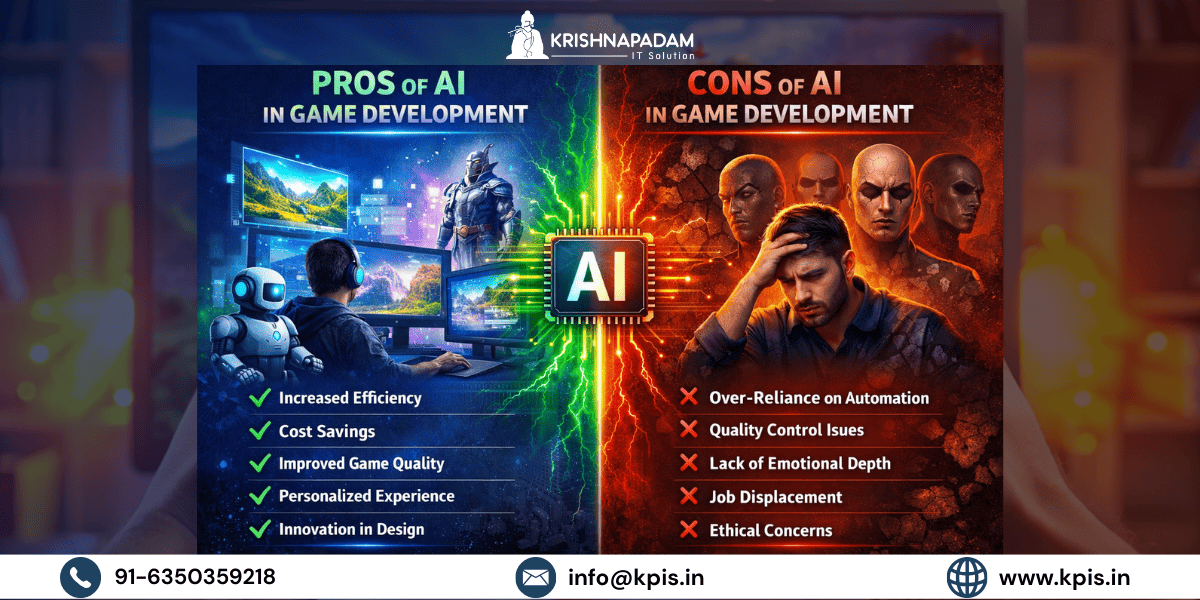
Pros of AI in Game Development:
- Increased Efficiency:- AI automates many repetitive tasks that traditionally require manual work, such as generating environments, creating animations, or testing gameplay mechanics. This leads to faster development cycles.
- Cost Savings:- By automating certain aspects of development, AI can reduce the need for a large workforce, cutting down on labor costs. AI-driven content creation tools also reduce the need for expensive resources and assets.
- Improved Game Quality:- AI allows for highly dynamic gameplay and sophisticated NPC behaviors, improving the overall experience for players. Additionally, AI-driven testing tools can identify bugs and issues faster and more thoroughly.
- Personalized Gaming Experience:- AI can learn from player behavior and tailor the gameplay experience to suit individual preferences, leading to more engaging and personalized experiences.
- Innovation in Game Design:- AI can facilitate the creation of entirely new game mechanics or game types that may have been difficult to conceive or develop manually.
Cons of AI in Game Development:
- Over-Reliance on Automation:- While AI can speed up development, an over-reliance on AI tools could lead to a lack of human creativity and intuition in game design.
- Quality Control:- AI-generated content may not always match the level of quality expected from human creators, especially when it comes to art, animation, and narrative storytelling.
- Lack of Emotion in NPCs:- Although AI can simulate intelligent behavior, NPCs may still lack the depth and emotional complexity of human-designed characters.
- Job Displacement:- As AI automates more aspects of game development, there may be concerns about job loss or a reduction in the need for specific skill sets within the gaming industry.
- Ethical Issues:- As AI begins generating content autonomously, questions about authorship, ownership, and ethical use of AI-generated work may arise.
The Future of Game Development
By 2030, Artificial Intelligence is expected to move from being a support tool to becoming a core creative collaborator. Game studios will rely on AI not just to automate tasks but to enhance storytelling, personalize experiences, and expand the scale of what’s possible.
Here’s what that future may look like:
- Smarter NPCs and AI Companions:- AI will continue to refine NPC behavior, making in-game characters more autonomous, reactive, and lifelike. Players can expect NPCs that respond intelligently to their actions, leading to a more immersive experience.
- Automated Game Design:- AI-powered design tools will assist developers in creating complex game worlds, characters, and quests. Procedural content generation, powered by AI, will enable endless possibilities for game environments that react dynamically to player input.
- Advanced Personalization:- Games will become more personalized, adapting not only in terms of difficulty but also in terms of the narrative, gameplay mechanics, and character development based on players’ preferences and actions.
- AI-Driven Game Testing:- AI will revolutionize the quality assurance process by running automated tests and simulations to ensure a bug-free gaming experience. Developers will be able to catch issues earlier, improving the overall game stability.
- More Immersive AI Narratives:- With the power of AI, stories in video games will become more dynamic and personalized. Players’ decisions will influence the storyline and the world around them, creating really unique gameplay experiences.
AI Game Development Company – KPIS Pvt. Ltd.
AI is no longer optional in game development. It’s the competitive edge.
Are you ready to level up your gaming experience with cutting-edge AI? At KPIS Pvt. Ltd., we build AI-powered game solutions that help studios create smarter gameplay, adaptive worlds, and scalable production pipelines. From intelligent NPC behavior to procedural world generation and AI-assisted testing, our team integrates advanced technologies that reduce development time and elevate player experience.
The future of gaming belongs to studios that combine creativity with intelligent systems. At KPIS, we don’t just develop games. We build AI-driven gaming experiences designed for the next generation.
- Experienced AI & Game Development Team
- Scalable Architecture & Secure Systems
- Innovation-Driven Approach
- Future-Ready Gaming Solutions
By incorporating AI, we produce dynamic, personalized gameplay experiences. Also, improve game quality through faster testing and bug identification, and create expansive, engaging worlds. Our goal is to push the boundaries of gaming by combining creative design with cutting-edge AI innovations.
Hire AI Game Developers at KPIS Pvt. Ltd.
Looking for talented AI game developers to bring your ideas to life? Hire skilled game developers at KPIS Pvt. Ltd. Our team is well-versed in the latest AI technologies and trends. Including deep learning, neural networks, and reinforcement learning, which we apply directly to game development.
Conclusion
Artificial Intelligence is no longer just automating development tasks. It is redefining how games are imagined, designed, and experienced.
From intelligent NPCs to adaptive storytelling and personalized gameplay, AI is expanding the boundaries of interactive entertainment. The studios that embrace this transformation today will lead the gaming industry tomorrow.
At KPIS Pvt. Ltd., we are passionate about turning AI innovation into immersive gaming experiences. Our expert game development team collaborates closely with clients to build scalable, intelligent, and future-ready solutions powered by advanced AI technologies.
If you’re ready to explore how AI will shape game development over the next five years, now is the time to act.
Let’s build smarter systems.
Let’s design adaptive worlds.
And let’s create next-generation AI-powered games together.
Start your AI-driven game development project. Also, learn more about AI in game development: the changes that will transform gaming by 2030, don’t hesitate to reach out. We’re eager to start building the next-generation AI-powered games with you. Let’s create the future of gaming together!
FAQ’s- AI in Game Development