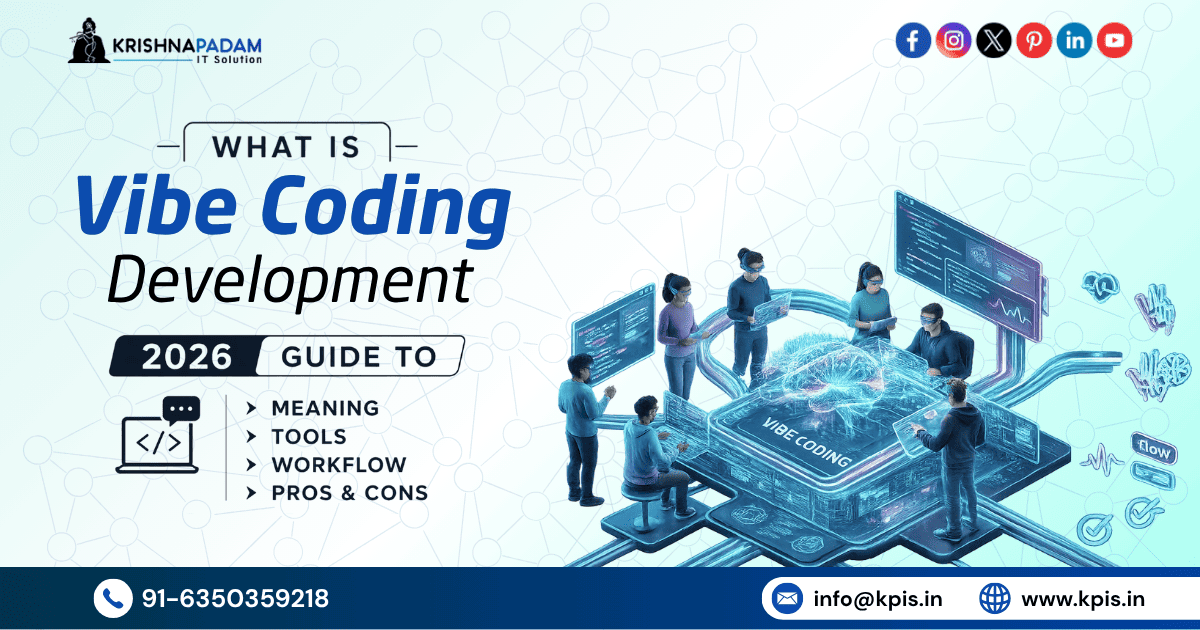
Did you know? By early 2026, over 65% of developers report using AI-assisted tools daily, and nearly 40% of new apps are now built with some level of “vibe-first” development rather than traditional coding workflows. In this blog, you’ll learn, What Is Vibe Coding Development? 2026 Guide. How it works, the tools powering it, and its advantages and risks in modern software development.
Welcome to the era of Vibe Coding Development– a shift that’s redefining how software is imagined, created, and shipped. The way we build software is undergoing a massive transformation. “Vibe coding” isn’t just a trend, it’s becoming the default mindset for modern developers, creators, and even non-technical founders. In 2026, coding is less about memorizing functions and more about communicating ideas effectively to AI systems.
So what exactly is vibe coding, and why is everyone talking about it? Let’s break it down.
What is Vibe Coding? (The Simple Explanation)
Vibe Coding Development is a modern approach to building software where intent, creativity, and user experience (“the vibe”) take priority over rigid code structures from the start. Instead of beginning with technical architecture, developers (and even non-developers) start with a feeling, outcome, or experience they want to create and use AI tools, visual builders, and rapid prototyping systems to bring it to life.
In simple terms: You describe what you want. AI and tools help build it. You refine the vibe until it feels right.
Vibe Coding vs No-Code vs Low-Code
Vibe Coding
- How it works: Prompt-based (you describe, AI builds)
- Skill needed: Basic logic + clear communication
- Flexibility: Extremely high
- Best for: Developers, creators, startups, rapid prototyping
You can build almost anything because you’re not limited to templates, you’re only limited by how well you can explain your idea.
No-Code
- How it works: Drag-and-drop interfaces
- Skill needed: No programming knowledge
- Flexibility: Limited to platform features
- Best for: Beginners, simple apps, landing pages
Examples include website builders and automation tools where you visually assemble components.
Low-Code
- How it works: Mix of visual tools + some coding
- Skill needed: Basic to intermediate coding
- Flexibility: Moderate to high
- Best for: Businesses, internal tools, faster enterprise development
It gives more control than no-code but still speeds up development compared to full coding.
How Does Vibe Coding Development Actually Work?
Here’s the honest truth: vibe coding feels magical on the surface but underneath, it’s a structured loop of prompting, generating, validating, and refining.
Most people think you just “type a prompt and get a perfect app.” That’s not how it works in real-world development.
What actually happens is closer to this:
- You describe an idea
- AI generates a rough version
- You critique and refine it
- Repeat until it’s production-ready
It’s less like pressing a button and more like directing a very fast but literal junior developer.
The Basic Vibe Coding Workflow (Step by Step)
Vibe coding isn’t random prompting it’s a repeatable system. The developers who get the best results follow a clear workflow that turns messy ideas into working products. Here’s how it actually works in 2026:
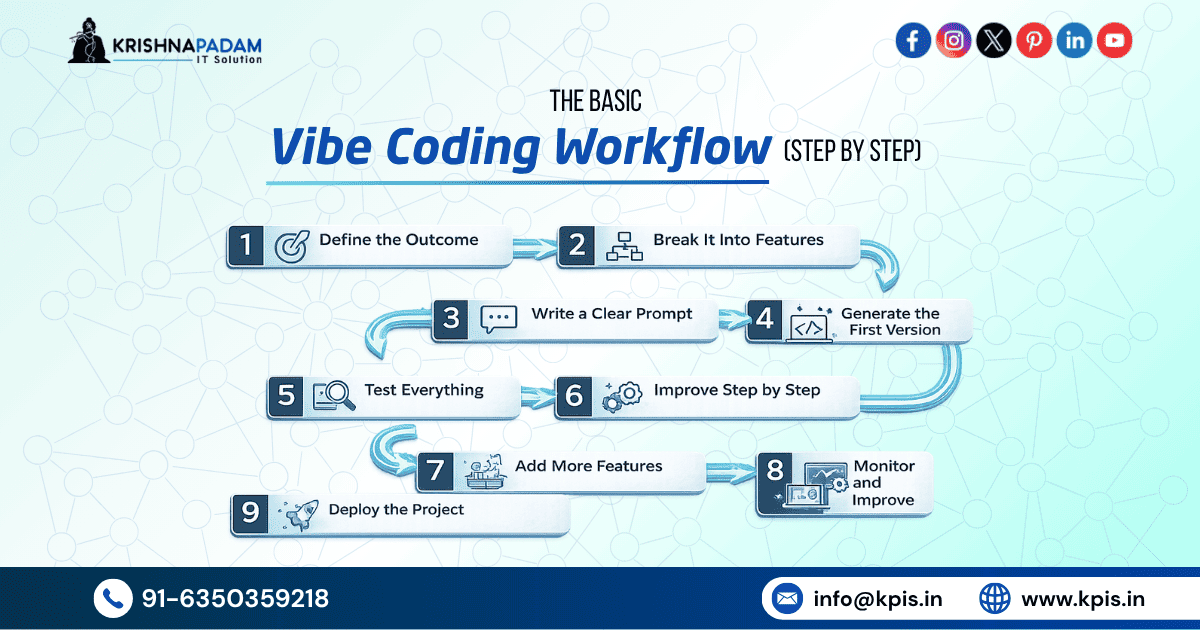
Step 1: Define the Outcome
Start by clearly describing what you want to build and why. Focus on the end result—who will use it and what problem it solves. The clearer your goal, the better the AI can understand you.
Step 2: Break It Into Features
Divide your idea into smaller parts like pages, features, or actions. This makes your project easier to build and helps AI generate more accurate results.
Step 3: Write a Clear Prompt
Explain your idea in simple, specific language. Include what features you want, how it should look, and any preferences. Good prompts save time and reduce errors.
Step 4: Generate the First Version
Let the AI create the initial version of your app or code. This is just a starting point, so don’t expect it to be perfect.
Step 5: Test Everything
Check if everything works properly. Click buttons, enter data, and try to break things. Testing helps you find issues early.
Step 6: Improve Step by Step
Fix problems and make improvements using clear instructions. Focus on one issue at a time instead of changing everything at once.
Step 7: Add More Features
Once the basics work, slowly add advanced features like login systems or integrations. Build gradually to avoid confusion.
Step 8: Deploy the Project
Put your project online using platforms like Vercel or Netlify so others can access it.
Step 9: Monitor and Improve
After launching, keep improving your app. Fix bugs, update features, and make the experience better based on feedback.
Vibe Coding Tools You Need in 2026
The modern developer’s toolkit for flow, speed, and AI-augmented building. Below is a curated breakdown of the most important vibe coding tools shaping modern development workflows in 2026.
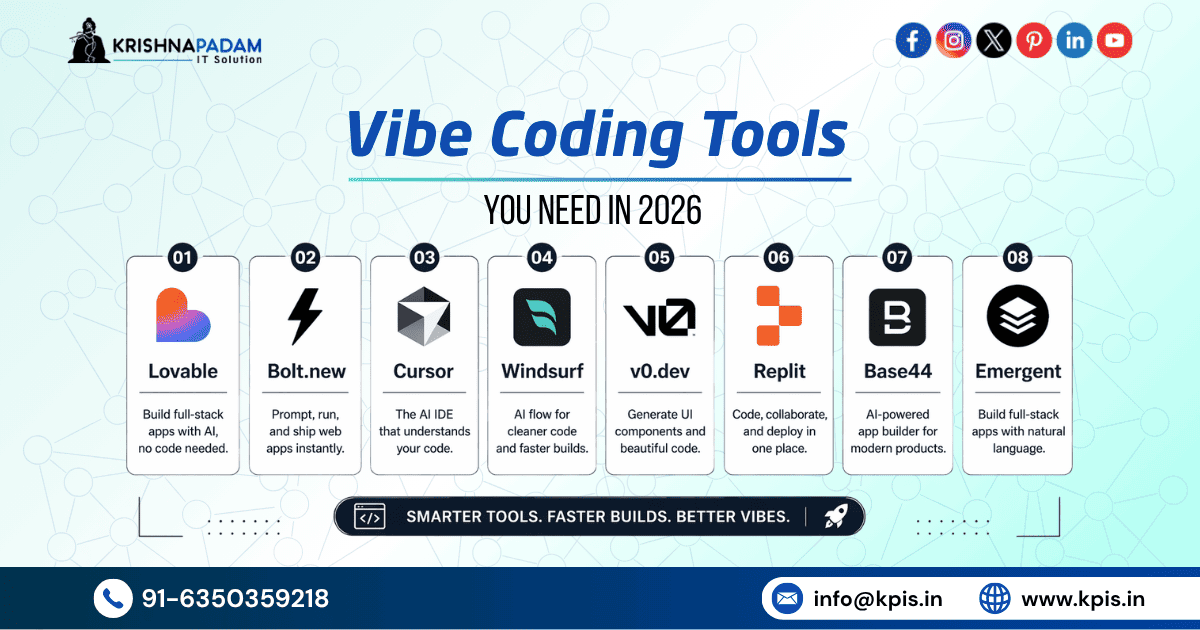
Lovable- Best for No-Code Full-Stack MVP Development
Lovable is one of the most powerful tools for founders and non-coders.
Key Features:
- Builds full-stack applications using prompts
- Automatically configures backend, frontend, and databases
- Integrates authentication and deployment seamlessly
Why it matters:
Lovable removes traditional development complexity, allowing users to ship production-ready MVPs without coding experience.
Bolt.new- Fastest Prompt-to-App Builder
Bolt.new is designed for instant web app creation directly in the browser.
Key Features:
- Zero setup required
- Instant deployment from prompts
- Ideal for rapid prototyping
Why it matters:
It is one of the fastest ways to turn ideas into working applications in minutes.
Cursor- Leading AI Code Editor
Cursor is an AI-first integrated development environment (IDE).
Key Features:
- Deep understanding of entire codebases
- Multi-file editing with AI assistance
- Context-aware code generation
Why it matters:
Cursor is the preferred choice for developers who want AI assistance without losing control over code quality.
Windsurf- Advanced AI Pair Programming IDE
Windsurf is built for large-scale software engineering projects.
Key Features:
- Strong context awareness across repositories
- Advanced AI pair programming capabilities
- Supports complex multi-step development tasks
Why it matters:
It enables teams to handle enterprise-level applications more efficiently using AI collaboration.
v0.dev- UI Component Generator by Vercel
v0.dev specializes in frontend development.
Key Features:
- Generates React components from prompts
- Produces production-ready UI designs
- Speeds up frontend workflows significantly
Why it matters:
It dramatically reduces the time required to build modern UI systems.
Replit- All-in-One Cloud Development Platform
Replit is a browser-based coding and deployment environment.
Key Features:
- Write, run, and deploy code instantly
- Beginner-friendly interface
- Supports collaboration and cloud hosting
Why it matters:
It makes software development accessible to beginners and educational users.
Base44- Creative 3D Development Tool
Base44 focuses on interactive and 3D web experiences.
Key Features:
- Supports Three.js-based development
- Enables creative and immersive web projects
- Ideal for experimental UI/UX work
Why it matters:
It bridges the gap between traditional web apps and interactive 3D experiences.
Emergent- Autonomous Full-Stack App Builder
Emergent is an agent-driven development platform.
Key Features:
- Generates complete full-stack applications
- Handles multi-step development tasks autonomously
- Reduces manual coding requirements
Why it matters:
Emergent represents the future of AI-driven software engineering.
also check: How Agentic AI Reduced Our Client’s Support Costs by 60% in Just 6 Weeks
The Advantages of Vibe Coding Development
Vibe coding is rapidly becoming the preferred development approach for startups, indie developers, and even enterprise teams. Its biggest strength lies in how it reduces friction between idea and execution.
Faster Product Development
- Vibe coding significantly reduces development time by generating code, UI, and backend logic instantly. Developers can move from idea to working prototype in hours instead of weeks.
Lower Barrier to Entry
- Non-developers can build real applications using prompts and AI tools. This removes the need for deep programming knowledge to create functional software.
Full-Stack Automation
- Modern vibe coding tools handle frontend, backend, databases, authentication, and deployment automatically. This eliminates most manual setup work in traditional development.
Increased Productivity
- Developers act more like architects while AI handles repetitive coding tasks. This leads to faster development cycles and reduced mental overhead.
Faster Experimentation
- Since building is quick, teams can test multiple ideas rapidly. This improves innovation and helps validate product-market fit sooner.
The Disadvantages & Risks of Vibe Coding
Despite its advantages, vibe coding introduces new challenges that teams must understand before adopting it fully.
Reduced Code Transparency
- AI-generated code is often harder to understand and review. This can make long-term maintenance and debugging more difficult.
Over-Reliance on AI
- Developers may depend too heavily on AI tools and weaken their core coding skills. This can become a problem in complex or unsupported scenarios.
Debugging Challenges
- While AI helps write code, it can also introduce hidden or unclear issues. Identifying root causes in generated code may still require strong technical understanding.
Security Risks
- Automatically generated code may not always follow best security practices. Without proper review, vulnerabilities can slip into production systems.
Tool Dependency (Vendor Lock-in)
- Many vibe coding platforms rely on closed ecosystems. Switching tools later can be difficult and may require rewriting parts of the project.
Is Vibe Coding the Future of Development? Will Vibe Coding Replace Software Developers?
Vibe Coding is very likely to become a core part of how software is built but it won’t replace software developers. It will reshape what their role looks like.
Why Vibe Coding is the Future
The shift toward Vibe Coding is happening because it solves real problems in traditional development:
- Speed: What used to take weeks can now take hours or days
- Accessibility: Non-technical founders can build functional products
- Cost efficiency: Smaller teams can achieve more with fewer resources
- Iteration: Ideas can be tested and improved rapidly
As AI tools continue to improve, the gap between idea and execution keeps shrinking. This makes Vibe Coding especially powerful for startups, product teams, and innovation-driven companies.
Why It Won’t Replace Developers
Despite its advantages, Vibe Coding still has clear limitations:
- Architecture decisions: AI struggles with designing large, scalable systems
- Complex logic: Edge cases and advanced business rules still require human thinking
- Security & compliance: Critical systems need expert oversight
- Debugging depth: AI can assist, but not fully replace deep debugging expertise
In other words, AI can generate code but it doesn’t fully understand responsibility, context, or long-term consequences the way experienced developers do.
How KPIS Pvt. Ltd. Helps You Go from Vibe Code to Production
What if your rough idea could become a live, scalable product in record time? At KrishnaPadam IT Solution, we transform “vibe code” into production-ready software using AI-driven development, agile workflows, and scalable architecture. Whether you’re launching a startup MVP or upgrading enterprise systems, we build fast, reliable, and user-centric applications designed to grow with you. Our dedicated developers bridges the gap between AI-generated prototypes and production-ready systems by offering:
- Code validation and optimization
- Security audits
- Scalable architecture design
- Deployment and DevOps support
- Ongoing maintenance
Conclusion with CTA
Vibe Coding is redefining how software is built in 2026. It empowers founders, developers, and businesses to move faster, innovate more, and reduce costs dramatically. If you’re ready to turn your idea into a production-ready product, now is the time to learn more what is Vibe Coding development? 2026 guide.
Ready to turn your idea into a high-performing product?
Hire experienced developers from KPIS Pvt. Ltd. and bring your Vibe Coding project to life with confidence. Get in touch today and start building smarter, faster, and better.